The UK’s BIM standards defines different maturity levels: 0,1,2 and 3. The key BIM related standard for Level 1 maturity is BS 1192:2007 + A2:2016 - Collaborative production of architectural, engineering and construction information – Code of practice. In order to achieve Level 1 maturity and subsequently Level 2 maturity, an organisation must show evidence that they are fluently adopting the principles and ways of working as defined in the BS 1192 standard; one of which includes complying with file naming conventions.
Whilst naming project documents in a uniformed manner may not seem that big of a task, the naming convention is highly complex. The detailed and tight definition provided by the standard leads to long file names with very explicit sections as illustrated below.
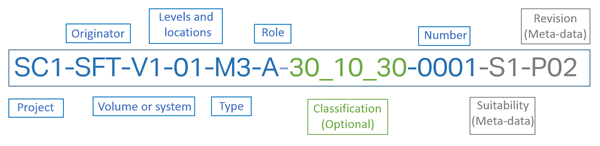
As a result, naming documents and drawings in accordance with the BS 1192 file naming convention can become quite laborious and potentially prone to error for many reasons:
- Whilst there are 7 required ‘fields’ to a file name, there can be as many as 12 when one adds ‘presentation’, ‘description’, ‘classification’, ‘suitability’ and ‘revision’. Simple typos and misinterpretations of the standard lead to mistakes, confusion and wasted time.
- The standard aims to be flexible and allow for all situations, but this flexibility can create problems in itself. For example the ‘originator’ field can be between 3 and 6 characters long, so staff could truncate a company name of ‘Rogerson Ltd’ to ‘RGN’ or perhaps ‘ROGERS’. Whilst both adhere to the standard, you would really want your staff to be consistent and only use one of these.
- It is often assumed that only drawings and models need to be named in accordance with BS 1192, when in fact ALL project documents should adhere to the file naming conventions.
A document and drawing management system can remove this hassle and the errors mentioned above by automatically naming all project documents for you; ultimately providing you with the first step to achieving BIM Level 1 & 2 maturity.
Note: the below webinar recording was created by Excitech prior to becoming Symetri in January 2021, following its acquisition by Addnode Group. All Excitech products, services and solutions mentioned in this recording are available through Symetri.
Watch the video above to learn how our document and drawing management solution Excitech DOCS can help your business become BIM compliant and save huge amounts of time, by automatically creating and naming documents in accordance with BIM standards from directly within your CAD software.
Learn more about Excitech DOCS and our other document management software here. Alternatively, feel free to call us on 0345 370 1444.